2010
Softcover Book Specs ORDER
ISBN: 978-0-9774657-3-6
AUTHOR: Larry Hancock
CLASSIFICATION: Biography/History
PRICE: $29.95.00 US
INDEX: Yes
ILLUSTRATIONS: 23 pages (B/W)
PAGES: appx. 50
SIZE: 6 1/8 X 9 1/8
PUBLISHER: JFK Lancer Productions & Publications
401 N. Carroll Ave, #204
Southlake, TX 76092
2006 Hardcover Book Specs
ORDER
ISBN: 0-9774657-1-3
AUTHOR: Larry Hancock
CLASSIFICATION: Biography/History
PRICE: $35.00 US
INDEX: Yes
ILLUSTRATIONS: 23 pages (B/W)
PAGES: appx. 600
SIZE: 6 1/8 X 9 1/8 |

Someone Would
Have Talked was written to demonstrate with available information,
the cover-up, the leaks, Lee Oswald, Jack Ruby and the people
that did talk, providing a cohesive and coherent explanation
of events. And in doing so this book gives the reader an introduction
to the history of the secret war against Castro and against Communism
during the 1960s, an introduction that is vital to an appreciation
of the individuals, and their motivations.
Someone Would Have Talked deals
with specific people who talked about their personal knowledge
of a conspiracy in the murder of a President. These individuals
include four men associated with the CIA’s JM WAVE station
in Miami Florida. Two of them were senior CIA officers, one
a veteran of three years of Castro assassination projects and
the other a three year prisoner of Castro - and an organizer
and participant, along with a former U.S. Ambassador, in one
of the most potentially explosive Cuban penetration missions
ever conducted.
|
ABOUT THE BOOK
- The initial investigation of President
Kennedy’s
assassination was hamstrung by a consistent pattern of damage
control and evidence management. Actions personally orchestrated
by President Johnson prevented a true open-ended criminal investigation
of leads suggesting conspiracy in the murder.
- A body of investigative documents
(FBI, CIA, NSA, HSCA, and ARRB) exist which reveal pre-assassination
leaks suggesting that President Kennedy was at risk prior to
the assassination; these leaks can be traced to Miami Florida
and tied to a common network of individuals shown to have been
associating with each other in 1963.
- Informant reports and private research
shows that Lee Oswald was in contact with, and influenced by,
this same network of individuals he initially came into contact
with in New Orleans during August of 1963. These individuals,
including two high ranking CIA officers and one highly placed
member of organized crime, can be shown to have been associated
with one another and connected with the CIA’s JM/WAVE operations
in Miami in 1963.
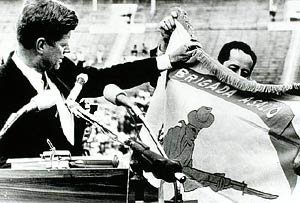
- Cuban
Exile John Martino, the common thread in the book, provided
limited details about a conspiracy against President Kennedy
to a reporter who had covered his return to Miami after years
of suffering in a Cuban prison. With a wealth of new information
only now available, Martino’s remarks have become increasingly
credible and provide unique insights into the conspiracy.
|
HANCOCK has long been considered one of the top investigative researchers in the areas of intelligence and national security. He has appeared as a guest speaker at numerous research conferences and in interviews for the Mary Ferrell Foundation. Hancock’s books have received endorsements and praise from former House Select Committee of Investigations staff members and the former Joint Historian for the State Department and Central Intelligence Agency. He lives in Oklahoma. more » « less
Larry is a graduate of the University of New Mexico with a BA in Education and majors in Anthropology, Sociology and Education. Following service in the United States Air Force, he worked in the telecommunications and computer communications fields for some 35 years - with Continental Telecom., Hayes Microcomputer and Zoom Technologies. During his career he
held the positions of Technical Trainer, Technical and Engineering Training Manager, Marketing Manager and Marketing Director. He become involved with Kennedy assassination research in the early 1990’s, and has focused on intelligence and national security aspects of the conspiracy. He has published a variety of document collections and analysis on CD with JFK Lancer, contributed articles and essays to JFK Lancer, DPUK and the Mary Ferrell Foundation. His first book, with Connie Kritzberg (former Dallas reporter) was November
Patriots, a docufiction piece on the Kennedy Assassination. His second book, Someone
Would Have Talked, (now in its third edition) is a factual study of the Kennedy conspiracy and cover-up. He followed it with a third book, published in 2011 - NEXUS
: The CIA and Political Assassination. Hancock has also done research on the RFK assassination, publishing a lengthy series of essays, Incomplete
Justice, on the Mary Ferrell website and, along with Stuart Wexler, has spent some five years researching the assassination of Martin Luther King Jr.. Visit Hancock's Amazon Page - Hancock's Blog & Book Links - Hancock on the Mary Ferrell Website Clips - RFK Study
|
