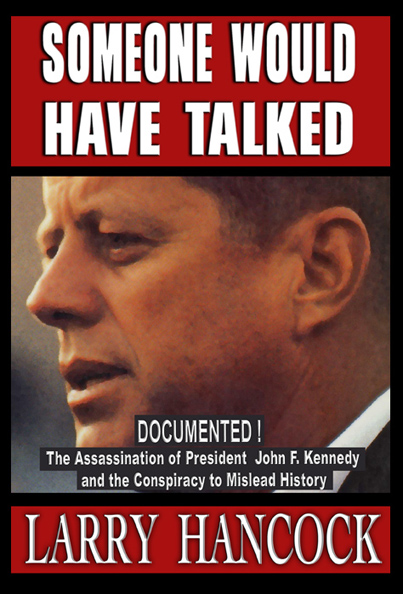
Someone Would Have Talked by Larry Hancock

Someone Would Have Talked: The Assassination of President John F. Kennedy and the Conspiracy to Mislead History by Larry Hancock


Chapter 1

John Martino knew that President Kennedy was going to be killed in Dallas.   He didn't know the details but he knew the people that were doing it – and he had helped them in small ways during his trips to Dallas that fall.

Martino was nervous that day, wanting to distance himself from what was going to happen and knowing that he couldn't.   He announced to his family that he would paint the breakfast room in his house.   But he had also asked his son, Edward, to stay home from school that Friday.   No reason given and no explanation offered.   During the morning, John asked Edward not to help paint but instead to watch television and to notify him immediately of any special news or bulletins.

Later, while catching a piece of coverage of the President's travels on the radio, John Martino exclaimed to his wife, “Flo, they're going to kill him.   They're going to kill him when he gets to Texas.”

That afternoon when Edward ran to his father with the news of an attack on the President, he watched his father turn white as a sheet.   As the afternoon passed, John Martino began receiving an ongoing series of telephone calls from Texas.

.............................................

Chapter 2

The younger man opened the conversation, “I'm Lee Oswald; I finally found you.   You are McKeown are you not?”   He introduced the man with him as “Hernandez.”   Hernandez had been driving the car.

After a bit of conversation the younger man came to the point, “I understand that you can supply any amount of arms…we are thinking about doing a revolution in El Salvador.”  

McKeown was still on probation for handling shipments of guns for former Cuban President Prio Soccares and getting them delivered to Fidel Castro in Cuba. Hence, McKeown wanted nothing to do with any new gun deal.   As quickly as possible he got the two out of the house and told Sam Neal, “Sam, ain't that a hell of a mess.”

But the men came back to the door and McKeown stepped out as if leaving the house and Oswald tried again: “Mac, would you do me a favor?   It will not involve you in any way.   I can give you $10,000 if you can get me four rifles, 300 Savage automatics with a telescopic sight.”  

..........................................

Chapter 2

Sylvia Odio's visitors were three men, including two who were described by both Anne and Sylvia as “looking more Mexican than anything else,” and one American who spoke poor Spanish (apparently understanding even less).

One or two days later, Sylvia received a call during which one of the men made the casual comment that the American with them was named “Leon.” “He was an ex-Marine, an expert marksman and he would be a tremendous asset to anyone, except you never know how to take him.   He could do anything, like getting underground in Cuba, like killing Castro.   He says we Cubans don't have any guts, we should have shot President Kennedy after the Bay of Pigs.   He says we should do something like that.”

..........................................

Chapter 5

On November 11, 1963, in Miami, Jorge Soto Martinez was apparently trying to impress Mrs. Lillian Spingler, an employee at the Parrot Jungle gift shop.   Martinez bragged that both he and his friend Lee (who was living in either Mexico or Texas) were sharpshooters.   Lee also spoke Russian, and he and Martinez both hated Kennedy; he could “shoot Kennedy between the eyes.”   Mrs. Spingler had described this conversation to other employees before the assassination and it was reported to the FBI in late December.

Former Dade County Circuit Judge Alfonso Sepe investigated the Spingler story again in 1977 and found it highly credible.   He also located one of her former co-workers, Mrs. Aliese Trigg, who recalled hearing of the conversation before the murder of the President.

However, when the FBI had interviewed her (Special Agent James O' Connor) she was given a firm suggestion: “ Just drop it…They told me not to talk about it…Goodbye .”

.................................

Chapter 14

At Red Bird airfield in South Dallas, Woburn Incorporated had been in the process of selling off a small fleet of DC3 transports which it had purchased to fulfill a contract that ended in 1963.   The last of the aircraft was sold in November and the new owner had arrived at Red Bird to collect his aircraft on November 18.   As part of the deal, Woburn had agreed to completely check the aircraft and perform any required repairs.   They had contracted with Wayne January to meet the new owner and the pilot that came with him.   The pilot spoke English with no accent but told January that he had been born in Cuba and eventually revealed that his boss was an Air Force Colonel.   The Cuban pilot was extremely proficient with the DC3 and later told January that he had flown that type of aircraft in Cuba as an officer in the Cuban Air Force.

By Thursday, November 21, January and the Cuban had become close enough to talk somewhat freely.   During their lunch break and after a period silence, the Cuban looked at January and said: “ They are going to kill your President .”   January could tell the man was not joking.   He had shown no sign of being less than serious before this in any conversation.   When January asked him why he was saying this, the Cuban talked about being involved in the Bay of Pigs and about being told how his friends had died because Robert Kennedy had talked John Kennedy out of sending the air support they had been promised for the invasion.   He talked about the pain and the embarrassment of those involved. "They are not only going to kill the President, they are going to kill Robert Kennedy and any other Kennedy who gets in that position."   January knew the man was serious, but it was too much for him to believe and he said so.   The Cuban closed the conversation with, “ You will see.”

................................

Chapter 14

On November 19, 1963 Jack Ruby told his tax attorney that he had suddenly managed to come up with the money to address his considerable back tax problems.   On November 22, Ruby would be seen with $7,000 in cash at his bank and was arrested with $3,000 in cash in his possession.   As of   November 19 th the supposedly cash strapped Ruby had begun talking to a realtor about a new location for his club, had inquired with someone in the travel business about a Caribbean cruise and told a friend that he planned on moving into a new apartment on Turtle Creek, at almost double his then current apartment rental rate.

.............................

Chapter 15

Admiral George Burkley, President Kennedy's personal physician, almost gave away the cover-up.   Doctor Aguilar notes that during an oral history for the JFK Library, Admiral Burkley was asked if he agreed with the Warren Commission in regard to the number of bullets that entered the President's body.   Burkley answered, “ I would not care to be quoted on that .”   Ten years later, Burkley's attorney, William Illig, contacted HSCA Counsel Richard Sprague about providing information to the Committee. “ Although he, Burkley, had signed the death certificate of President Kennedy in Dallas, he had never been interviewed and he has information in the Kennedy assassination indicating that others besides Oswald might have participated. "

............................

Chapter 16

It seems very likely that the FBI was bugging and monitoring Baker’s business partners not only because of their connection to Baker and potentially to Johnson, since Hoover always liked to keep his options open, but also because Baker’s business partners were linked to two of the biggest names in the syndicate world—Lansky and Dalitz.

Baker may or may not have known the implications. Hoover certainly would have, and certainly the associates of the gambling figures would have been aware of the potential impact of any associations with Baker or LBJ. However, what Black certainly did know and what he very likely told John Roselli was that Black, Baker, and a senior executive from North American Aviation had visited with the Vice-President in his office in the Executive Office Building. Not a long visit, only 15 minutes or so, but long enough to leave an entry in the official visitors log; long enough to produce concrete evidence that Johnson and the Vice President’s office were part of Baker’s influence peddling. This visit was recorded in the Vice President’s daily log for August 21, 1963, while Baker’s firm was consolidating its control over the lucrative vending machine business for North American and is provided in Appendix A.

There is no doubt that Johnson’s association with Baker and his business partners could have exposed LBJ to blackmail. The only questions are whether or not this was communicated to Johnson himself, and whether the approach may have been directly from Roselli. However, as with the Oswald damage control, actions and timing can provide further insight. Johnson’s reaction to the Baker scandal becomes visible in the Vice-President’s official diary for the months of October and November of 1963. These diaries were maintained by Johnson’s secretaries and are immensely detailed, recording virtually all of the Vice-President’s activities, often including the time he went to bed and his recreational activities. They are available through the Johnson Library.
The legal proceedings and Congressional investigations of Baker began in September of 1963, and by October the pressure was such that Baker was forced to resign his position with the Democratic National Committee.

............................

Chapter 19

During the evening of November 22, however, there are several people on record who received calls from President Johnson's assistant Cliff Carter.   On the morning of November 23, the Dallas Morning News carried a story quoting Dallas District Attorney Henry Wade that preliminary reports indicated more than one person might have been involved.   Regardless of what Wade had thought and told the reporters, the final charges filed against Oswald reflected the calls from Washington D.C. the previous evening.   Henry Wade described three calls from Cliff Carter on Friday night.   Carter said that “ any word of a conspiracy – some plot by foreign nations – to kill President Kennedy would shake our nation to its foundation.   President Johnson was worried about some conspiracy on the part of the Russians… it would hurt foreign relations if I alleged a conspiracy – whether I could prove it or not… I was to charge Oswald with plain murder .”   In addition to Wade, Police Chief Curry and Texas State Attorney General Carr also received similar calls from Cliff Carter, instructing them to avoid any charges or remarks indicating conspiracy.

............................